bookme for Customer success teams
Onboarding, check ins and renewals all need meetings. bookme lets customers book them and keeps the outcome recorded.
What you will learn
- Create an event type
- Share your link where people already are
- Share meetings across a team
- Automate reminders and follow ups
- Record what happened after each meeting
- Choose how the meeting happens
Who this is for
Customer success managers, onboarding specialists and account managers.
Customer success is about regular, useful contact. The risk is not a failed meeting, it is a meeting that never gets scheduled because nobody found the time. The work of scheduling is easy to defer, and silence is how accounts drift.
bookme gives each stage of the customer journey its own link, so booking is one click rather than one more task.
The scheduling problems in customer success
Onboarding calls take scheduling effort
Fair distribution
Check ins slip
Outcomes not captured
How bookme solves it
- Booking links in onboarding emails. See how to share your booking link.
- Routing. See how to create a team event.
- Outcomes. See how to record a meeting outcome.
- Follow ups. See how to use post meeting follow up emails.
See bookme in action
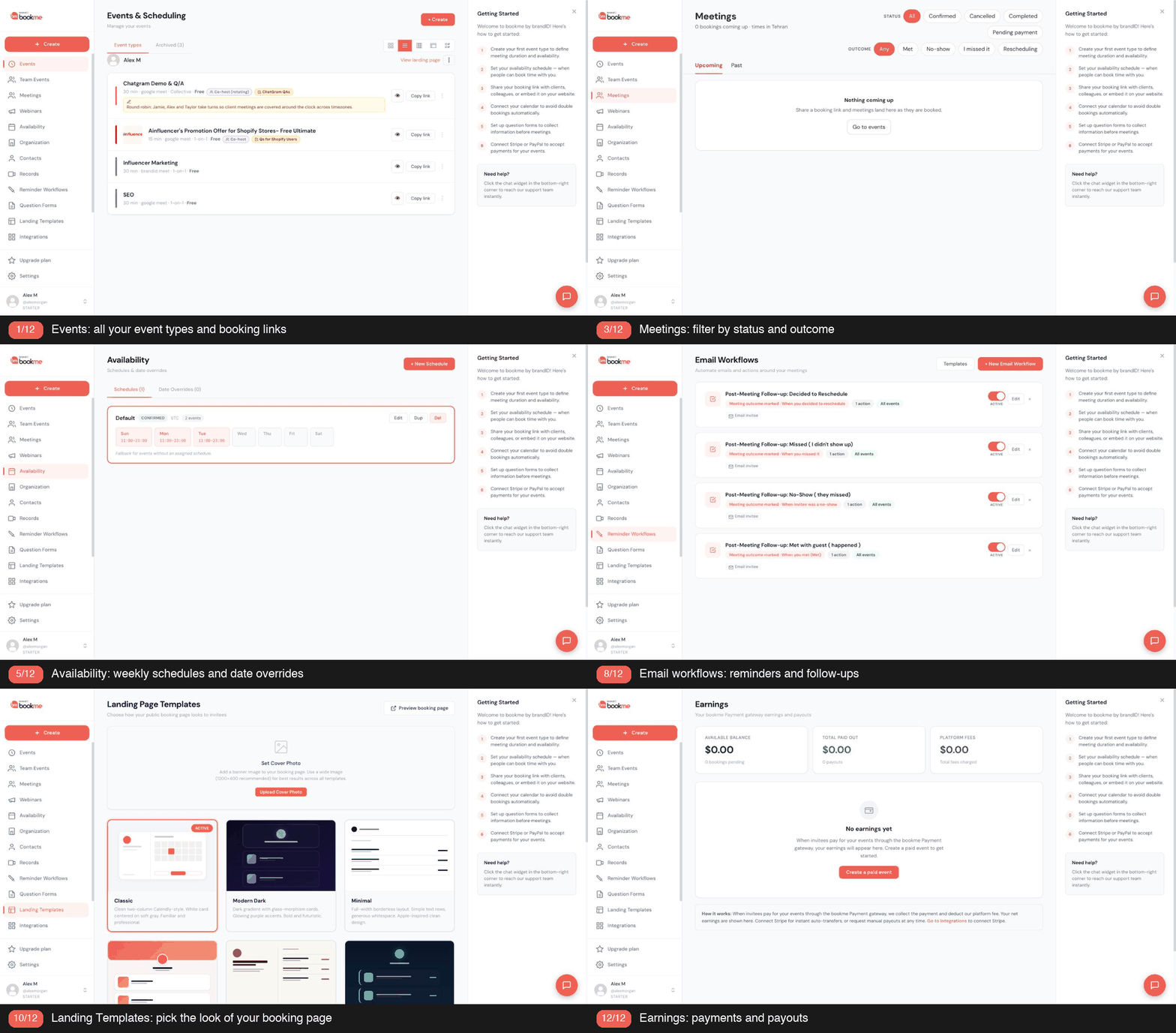
This short tour shows the dashboard you will use in the steps below: your events, meetings and settings in one place.
Set it up step by step
Create an event type
Each journey stage needs its own event.
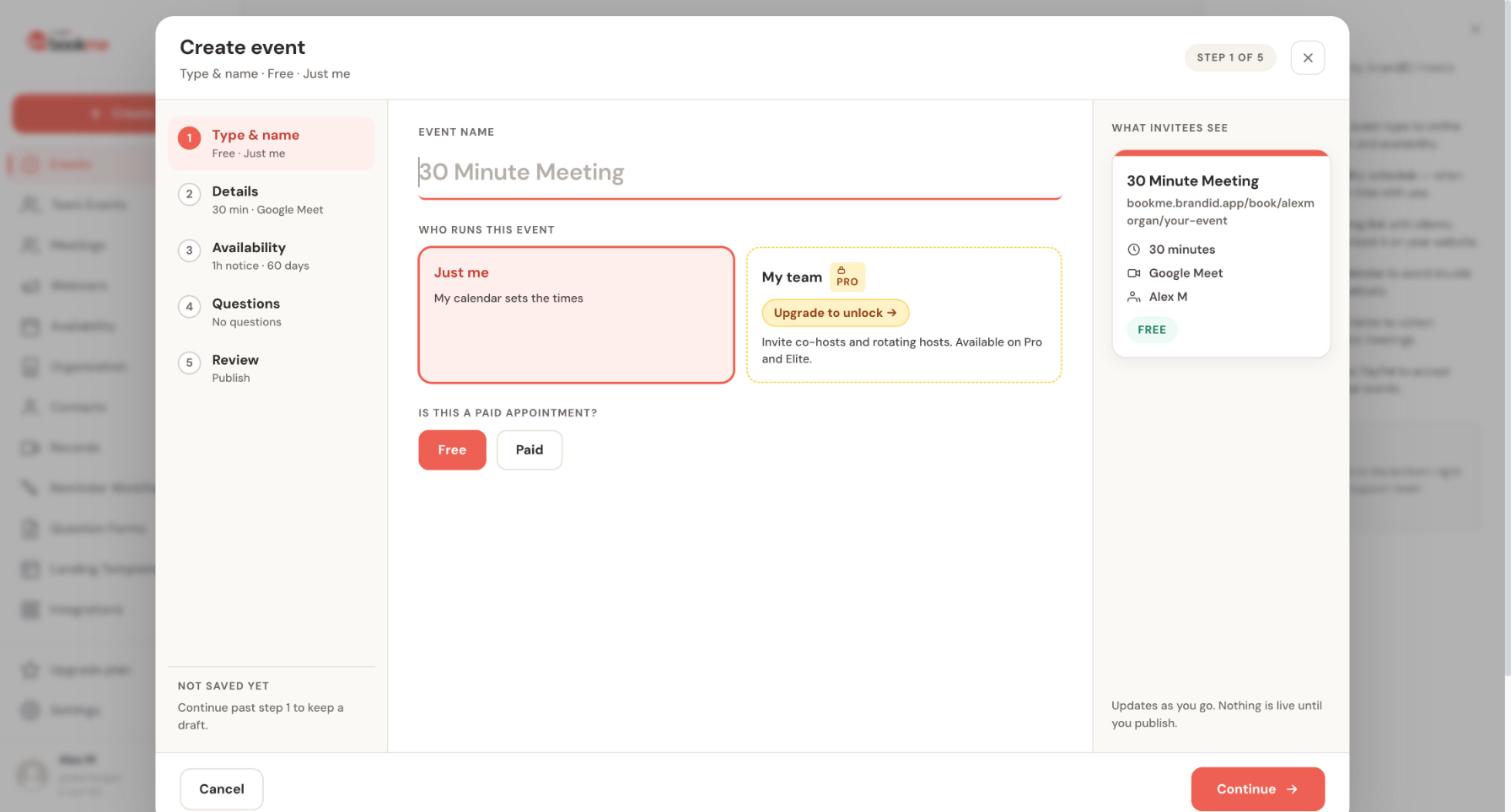
An event type is a meeting you offer, such as a 30 minute intro call. The Create event wizard builds one in five steps and keeps nothing public until you publish.
- On the Events page click + Create. The wizard lists five steps: Type & name, Details, Availability, Questions and Review.
- Name the event and choose Just me or My team, then choose Free or Paid.
- In Details set the description, the duration and the location: Google Meet, Zoom, brandID Meet, Phone call or In person.
- In Availability choose a schedule, how much notice you need, how far ahead people can book, an optional cap on bookings per day and buffers before and after each booking.
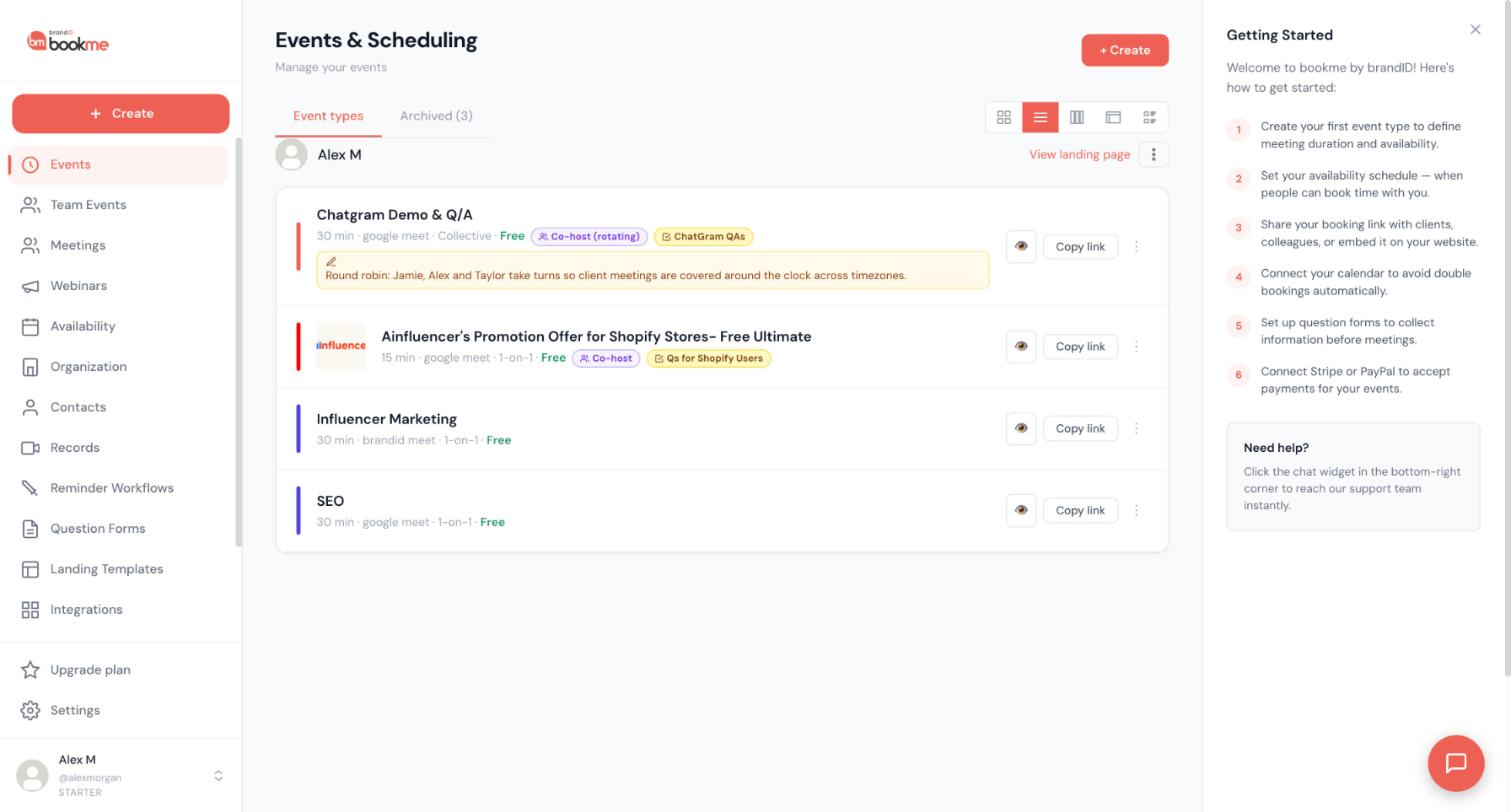
- Click Publish event, then use Copy link on the Events page to get the event’s direct link.
For customer success:
- Create Onboarding, Check in and Renewal events.
- Use different questions for each.
Full guide: how to create an event type.
Share your link where people already are
Links belong in the emails customers already read.
bookme gives you a link for your whole booking page and a direct link for each event type. Copy the one that fits and put it wherever people reach you.
- Use your booking page link when you want people to choose from every live event, and a direct event link when you mean one specific meeting.
- On the Events page click Copy link on an event card, or the small menu next to View landing page for your whole page.
- Click the eye icon to preview an event the way an invitee sees it, and try it on your phone.
- After you publish, copy the email signature line, or use the share buttons and QR code on the event is live screen.
- Keep your username and event slugs stable, because they are part of the links you have already shared.
For customer success:
- Put the onboarding link in the welcome email.
- Add check in links to regular emails.
Full guide: how to share your link where people already are.
Share meetings across a team
Round robin spreads onboarding across the team.
A team event lets several bookme users host the same booking, either all together or by taking turns.
- Check your plan first. Collective and round robin events are on the Elite plan.
- In the Create event wizard choose My team under Who runs this event.
- Choose how the team hosts: Everyone attends (collective), where a time is offered only when every required host is free, or Take turns (round robin), where one host takes each booking.
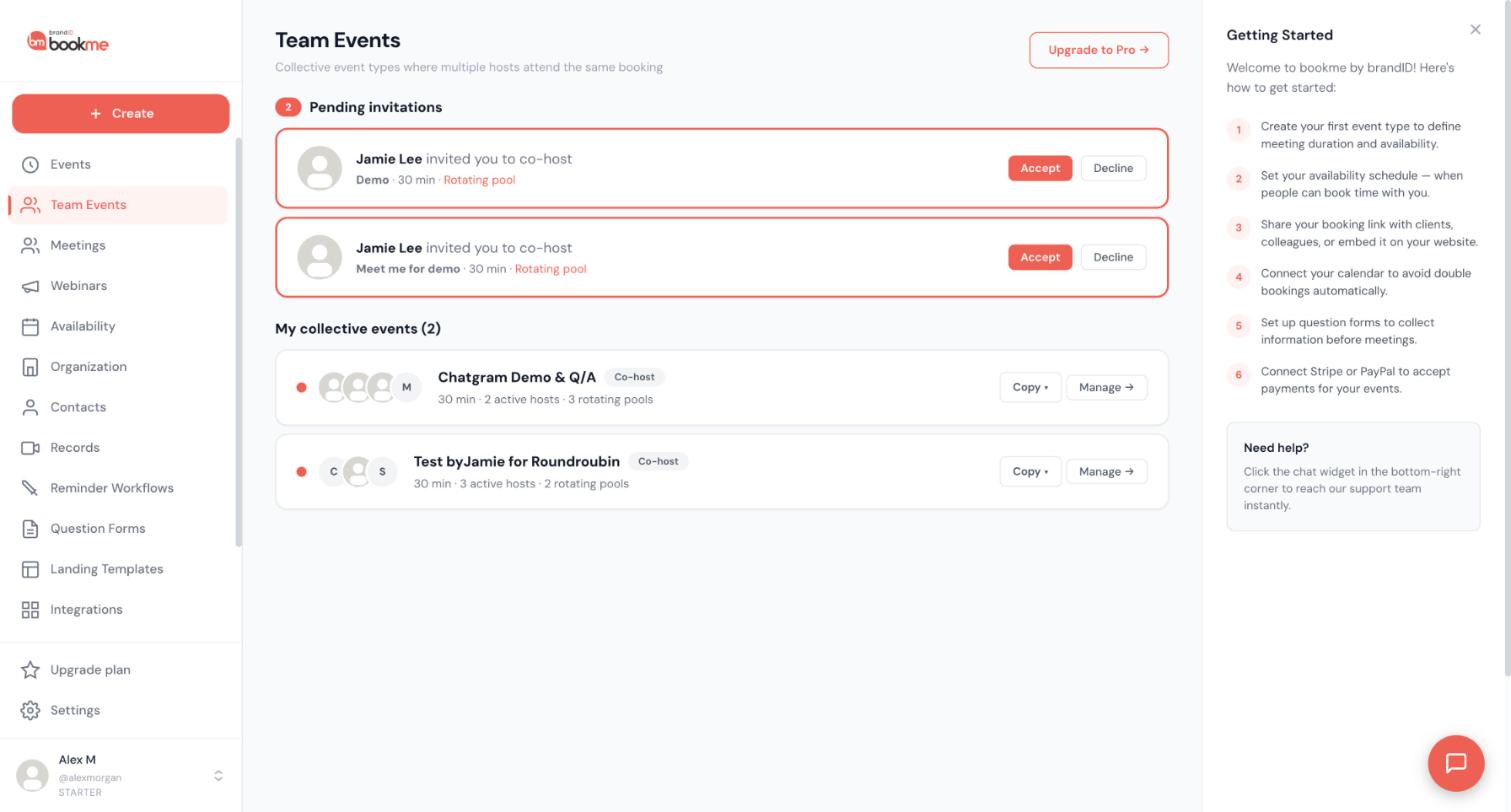
- Add co hosts by bookme username, by email or with an invite link. Each stays Pending until they accept.
- Publish the event, then manage it from Team Events.
For customer success:
- Use round robin for onboarding calls.
- Remember it is on the Elite plan.
Full guide: how to share meetings across a team.
Automate reminders and follow ups
Reminders and follow ups keep contact regular.
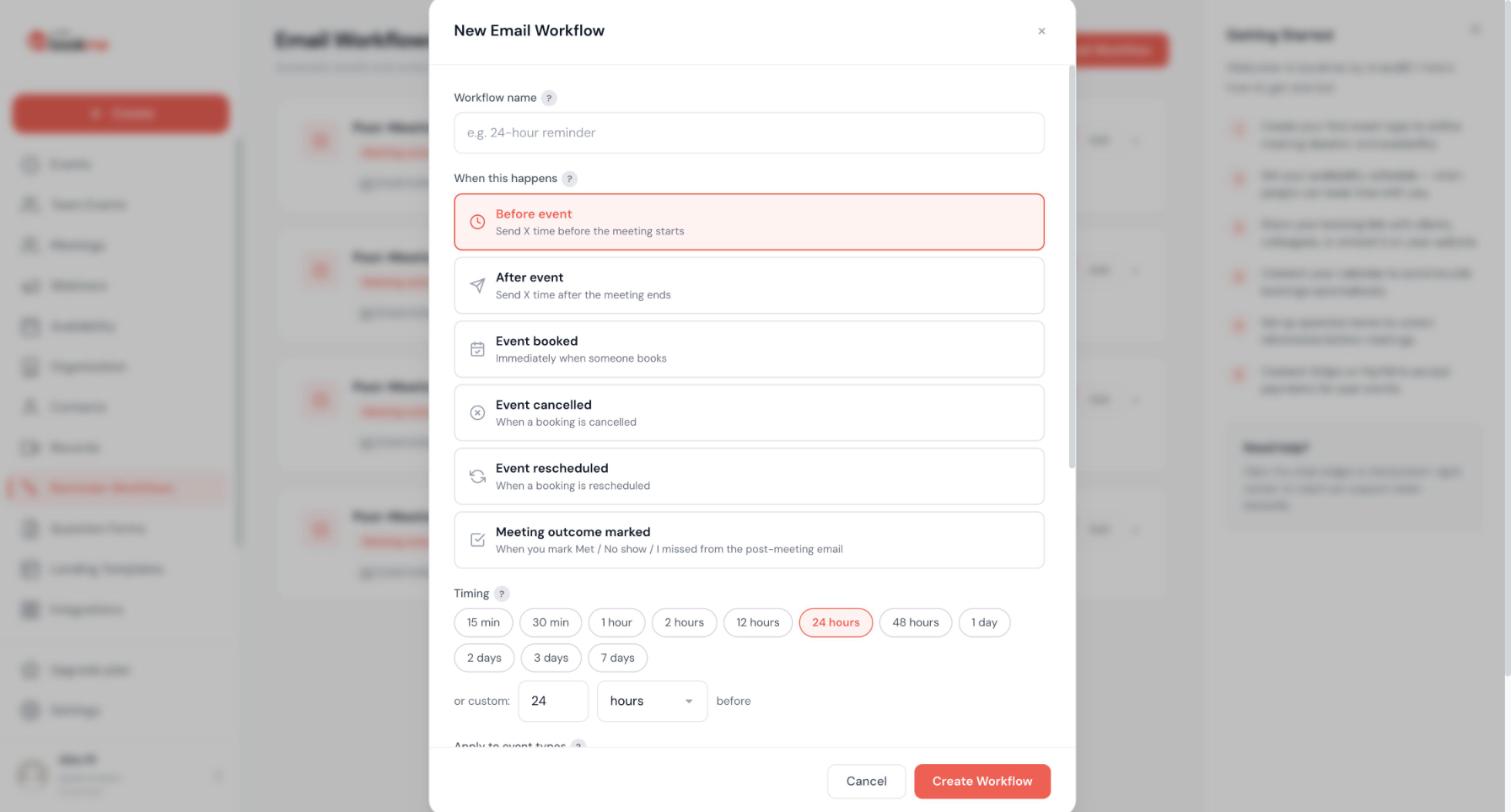
An email workflow sends an email when something happens around a meeting: before it, after it, or when it is booked, cancelled, rescheduled or marked with an outcome.
- Click Reminder Workflows in the sidebar, then + New Email Workflow, and name it, for example 24-hour reminder.
- Under When this happens choose a trigger: Before event, After event, Event booked, Event cancelled, Event rescheduled or Meeting outcome marked.
- For before and after triggers pick a timing chip such as 15 min, 1 hour or 24 hours, or enter your own.
- Choose which event types it applies to, leave it empty for all, and write the subject and body. You can insert merge variables such as {{invitee_name}} and {{event_name}}.
- Click Create Workflow and test it first with your own address.
For customer success:
- Send a reminder and a thank you.
- Include next steps.
Full guide: how to automate reminders and follow ups.
Record what happened after each meeting
Outcomes keep history with the meeting.
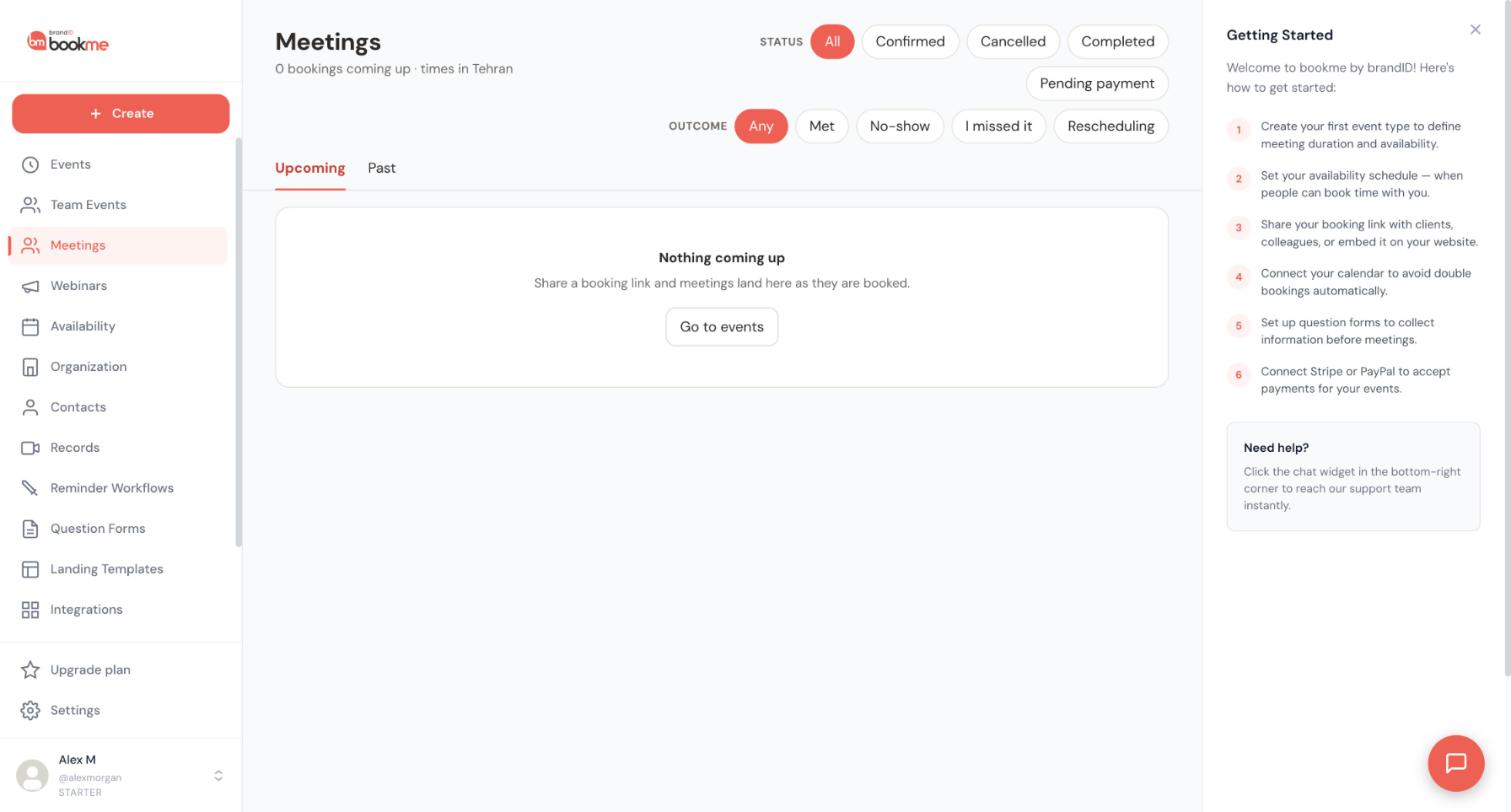
After a meeting ends, tell bookme what happened: Met, No-show, I missed it, or Decided to reschedule. Your answer sets the booking’s status and can send a follow up email to the invitee.
- Find the meeting that needs an outcome in the check in email sent five minutes after it ends, in the Just ended band on the Meetings page, or in the booking itself.
- Pick the outcome: Met, No-show, I missed it or Decided to reschedule.
- Review the window that opens. It shows a private note box and the follow up email exactly as the invitee will see it.
- Leave Email them now on to send it, or switch it off to save only your note.
- Later, use the Outcome filters on the Meetings page to review what happened.
For customer success:
- Mark each call and write a private note.
- Review outcomes weekly.
Full guide: how to record what happened after each meeting.
Choose how the meeting happens
Customers should always have a join link.
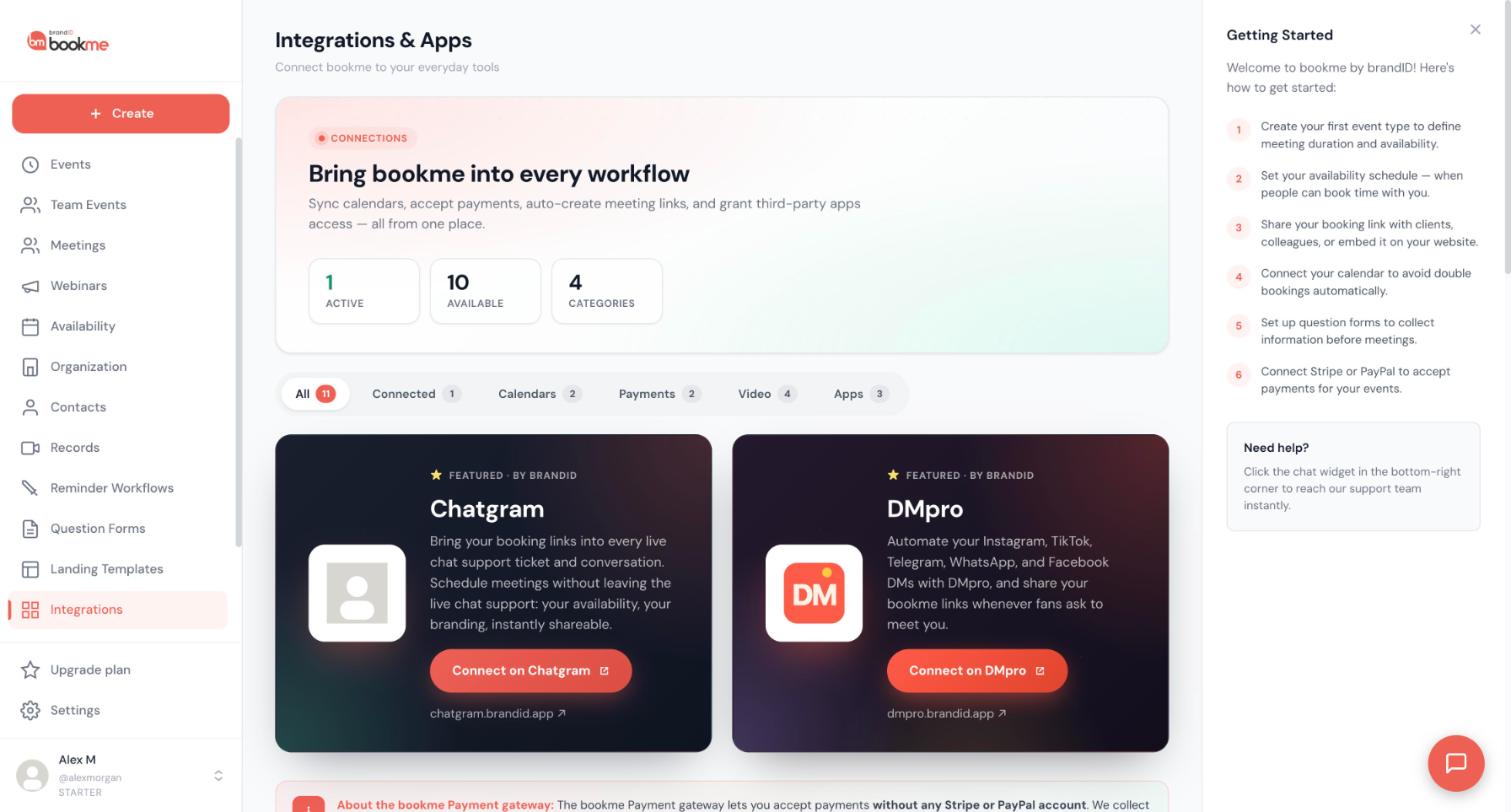
Choose the video tool for each event type and bookme puts a join link in every booking. brandID Meet needs no setup, Google Meet needs a connected Google Calendar, and Zoom needs a one time connection.
- Use brandID Meet with nothing to connect. Each booking gets its own room that runs in the browser, so the invitee installs nothing.
- To use Zoom, open Integrations, find the Zoom card, click Connect and authorize.
- To use Google Meet, connect Google Calendar. bookme then creates a Meet link inside the calendar event for each booking.
- Set the location per event type in the Details step: Google Meet, Zoom, brandID Meet, Phone call or In person.
- Find the join link on any booking in Meetings, where Join and Copy link appear.
For customer success:
- Choose a video tool per event.
- Check the link in a test.
Full guide: how to choose how the meeting happens.
Case study: a CSM team running onboarding and quarterly check ins
A team puts an onboarding link in the welcome email and a check in link in the quarterly email. Round robin on the Elite plan spreads onboarding calls. Each call is recorded with its outcome and a follow up goes out.
Customers who book a check in answer two questions in the form: what is going well and what is blocking them. The CSM reads the answers before the call and comes prepared with specific help.
For larger accounts, some teams add a second check in event for the technical contact, so that the executive sponsor and the day to day user each get a conversation that fits their role. Keeping these separate keeps both meetings short and focused, and it makes it easier to see which part of an account has gone quiet.
Before and after
Before:
- Onboarding is scheduled one email at a time
- New accounts are assigned by hand
- Check ins slip when teams are busy
- Meeting notes live in personal notebooks
After:
- Customers book onboarding from the welcome email
- Bookings can be shared across the team
- Check in links go out on a routine
- Outcomes are recorded with the meeting
A typical week with bookme
On Monday the CSM checks that new customers have booked onboarding. By midweek, two check in calls have happened and been recorded with outcomes. On Friday, the team reviews which accounts have not booked anything and sends them the link again with a short note.
Quarterly, the team looks at which event types are used and adjusts lengths and questions.
Launch checklist for customer success
Tick these off before you share your link.
- Each stage has an event.
- Links are in the right emails.
- Routing is chosen.
- Outcomes are recorded.
- Notes are kept.
Common mistakes to avoid
- Waiting for customers to ask. Send the link on a schedule.
- Using one generic meeting for everything. Onboarding and renewal need different questions.
- Forgetting to record outcomes, which leaves the next person without context.
Tips that make it work
- Use different events for different stages. Onboarding, health check and renewal each deserve their own length and questions.
- Send the link early. Include it in the email that goes out as soon as the customer signs.
- Record every outcome. Even a one line note helps whoever picks up the account next.
- Keep forms short. Two questions are plenty for a check in.
Let your AI assistant do the setup
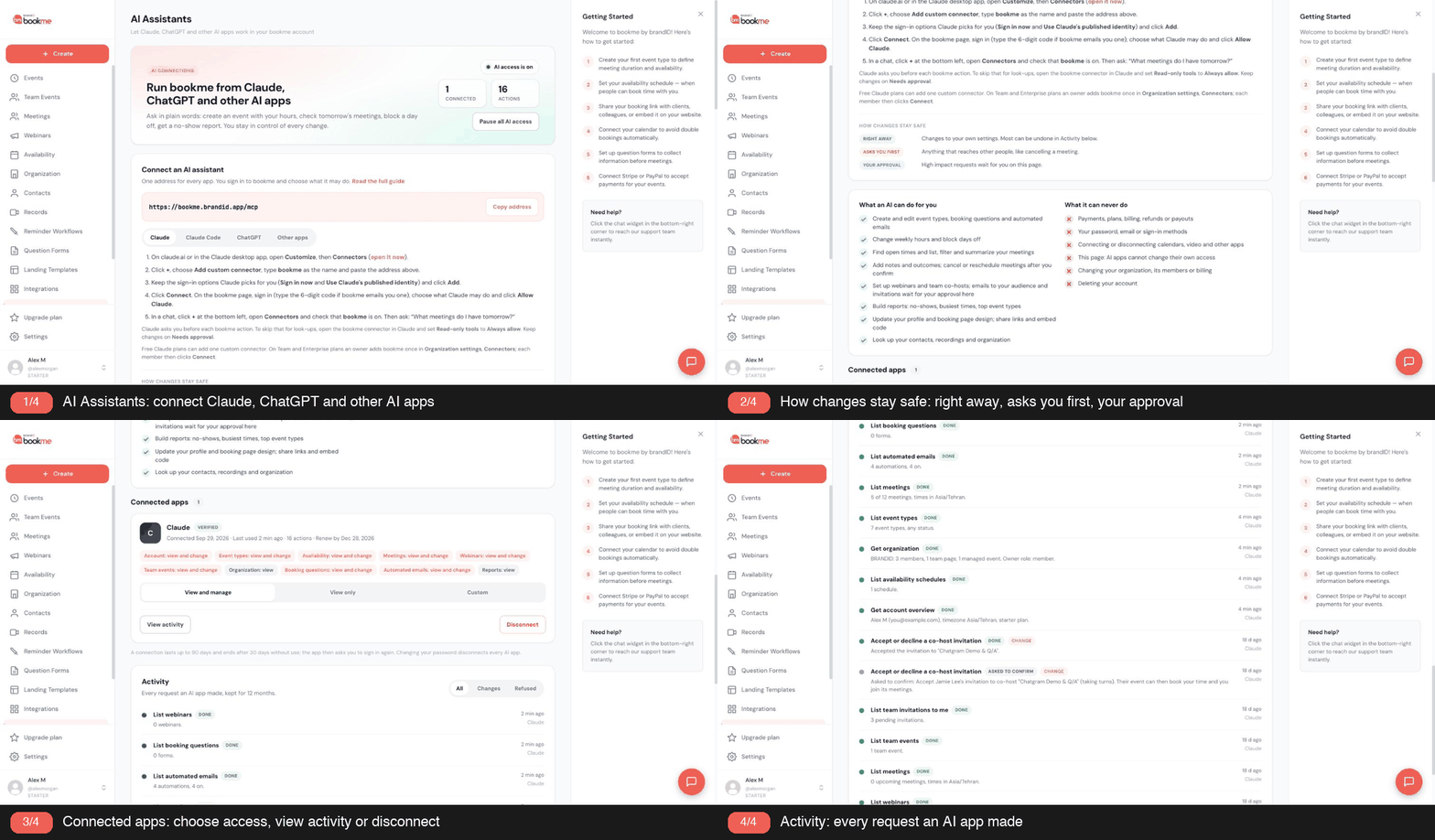
bookme works with Claude, ChatGPT and other MCP apps, so you can describe what you want in plain words and let your assistant build it. Anything that reaches another person, such as cancelling a meeting or emailing an invitee, waits for your approval first. Here is an example request for customer success:
Create onboarding and quarterly check in events, spread onboarding calls across three CSMs with round robin and add a thank you email after each call.
Setup guide: how to connect Claude to bookme.
Words you will see
- Event type. A meeting you offer, with its own length, location, price and rules.
- Schedule. A set of weekly hours that events can follow.
- Booking window. How much notice you need, and how far ahead people can book.
- Buffer. Time kept free before or after a booking.
- Question form. Custom questions invitees answer before they book.
- Collective event. All hosts attend, and a time is offered only when every required host is free.
- Round robin. Hosts take turns, with one host per booking.
- Email workflow. An email sent automatically before, after or around a meeting.
- Outcome. What happened to a meeting: Met, No-show, I missed it or Decided to reschedule.
Frequently asked questions
Can calls be shared across CSMs?
Can I record outcomes?
Can I send follow ups?
Do customers need an account?
Can customers reschedule on their own?
Can I see which meetings happened?
Ready to try it?
Add an onboarding link to your welcome email.