bookme for Real estate agents
Buyers and sellers want a viewing now, and your day is spent between properties. bookme lets them book viewings and consultations around the time you actually have.
What you will learn
- Create an event type
- Set your hours and protect your week
- Ask the right questions before the meeting
- Choose how the meeting happens
- Share your link where people already are
- Automate reminders and follow ups
Who this is for
Residential and commercial agents, brokers and property managers who schedule viewings, valuations and client consultations.
Real estate is a speed business. A buyer who messages three agents will often work with whoever replies first and makes viewing easy. At the same time, you are driving between properties and cannot always answer.
bookme lets buyers and sellers book from the listing itself, within the times you have opened.
The scheduling problems in real estate
Viewing requests arrive at all hours
Travel between showings
Unqualified enquiries
Last minute cancellations
How bookme solves it
- Viewing links. Share one link per listing or per type of meeting. See how to share your booking link.
- Buffers for travel. Set gaps between meetings. See how to set your weekly availability.
- Qualifying questions. Ask budget and timeline. See how to create a question form.
- Video or in person. Offer a call or video tour option. See how to set up video meetings.
See bookme in action
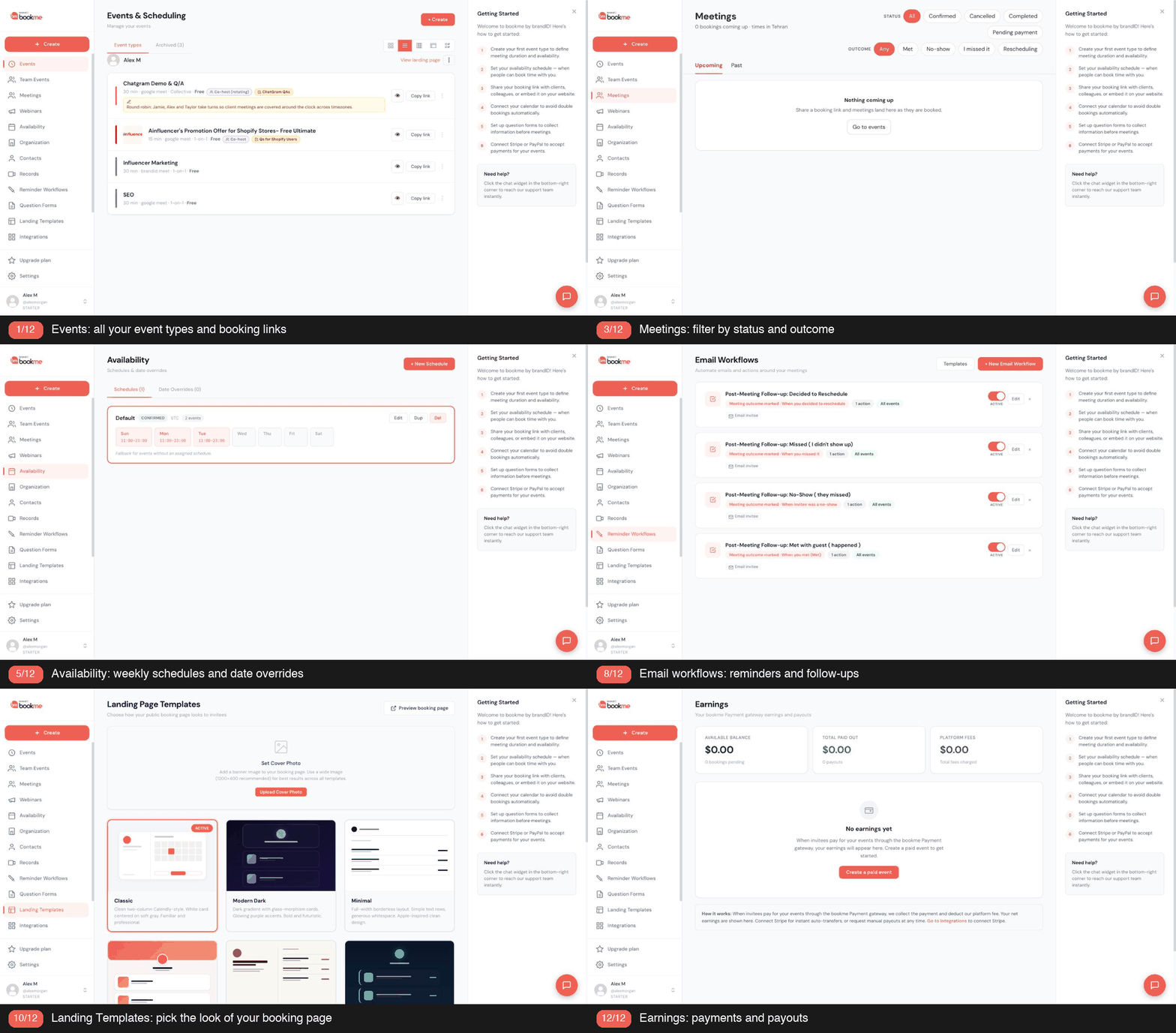
This short tour shows the dashboard you will use in the steps below: your events, meetings and settings in one place.
Set it up step by step
Create an event type
Viewings and valuations are different meetings.
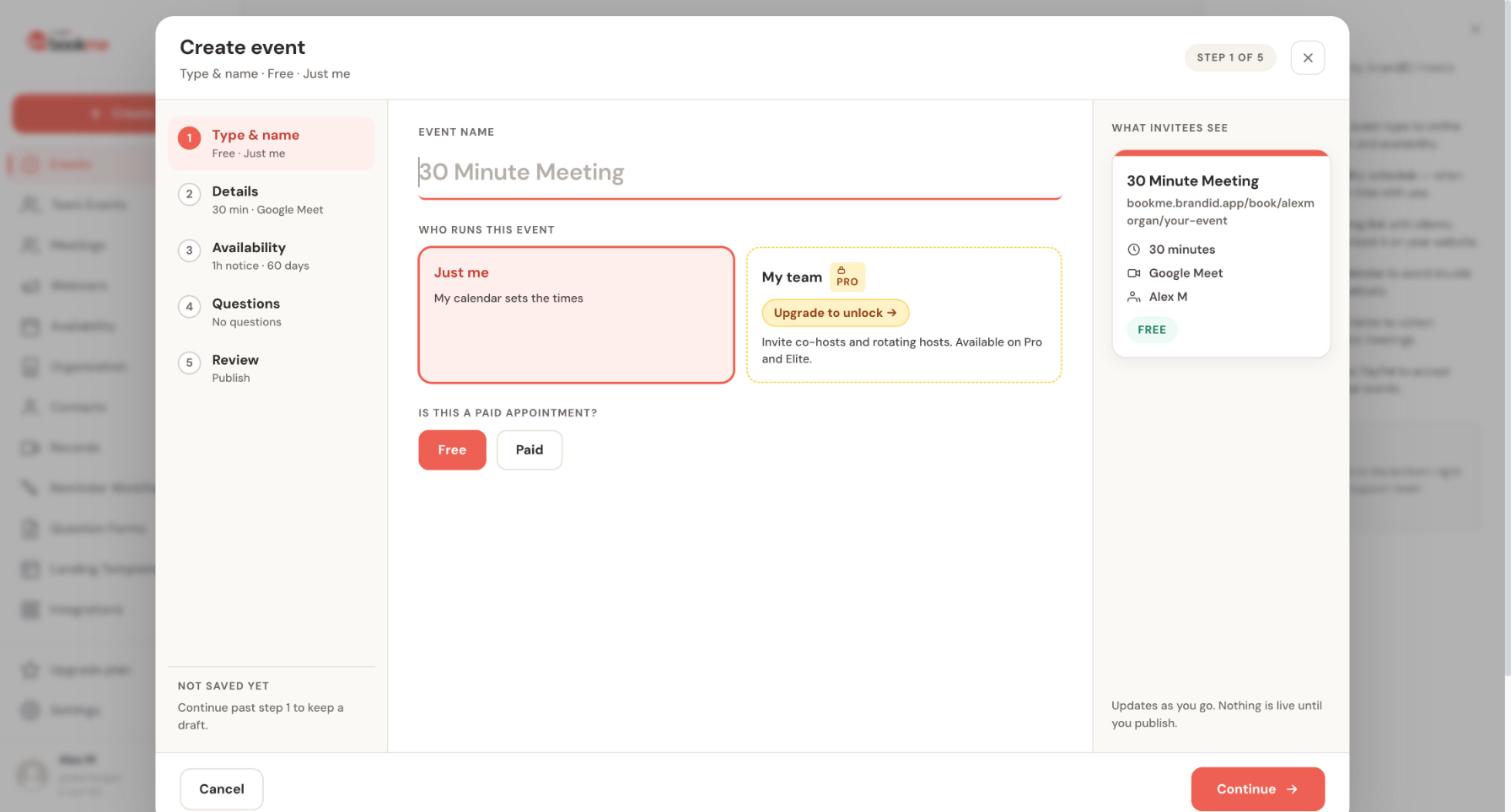
An event type is a meeting you offer, such as a 30 minute intro call. The Create event wizard builds one in five steps and keeps nothing public until you publish.
- On the Events page click + Create. The wizard lists five steps: Type & name, Details, Availability, Questions and Review.
- Name the event and choose Just me or My team, then choose Free or Paid.
- In Details set the description, the duration and the location: Google Meet, Zoom, brandID Meet, Phone call or In person.
- In Availability choose a schedule, how much notice you need, how far ahead people can book, an optional cap on bookings per day and buffers before and after each booking.
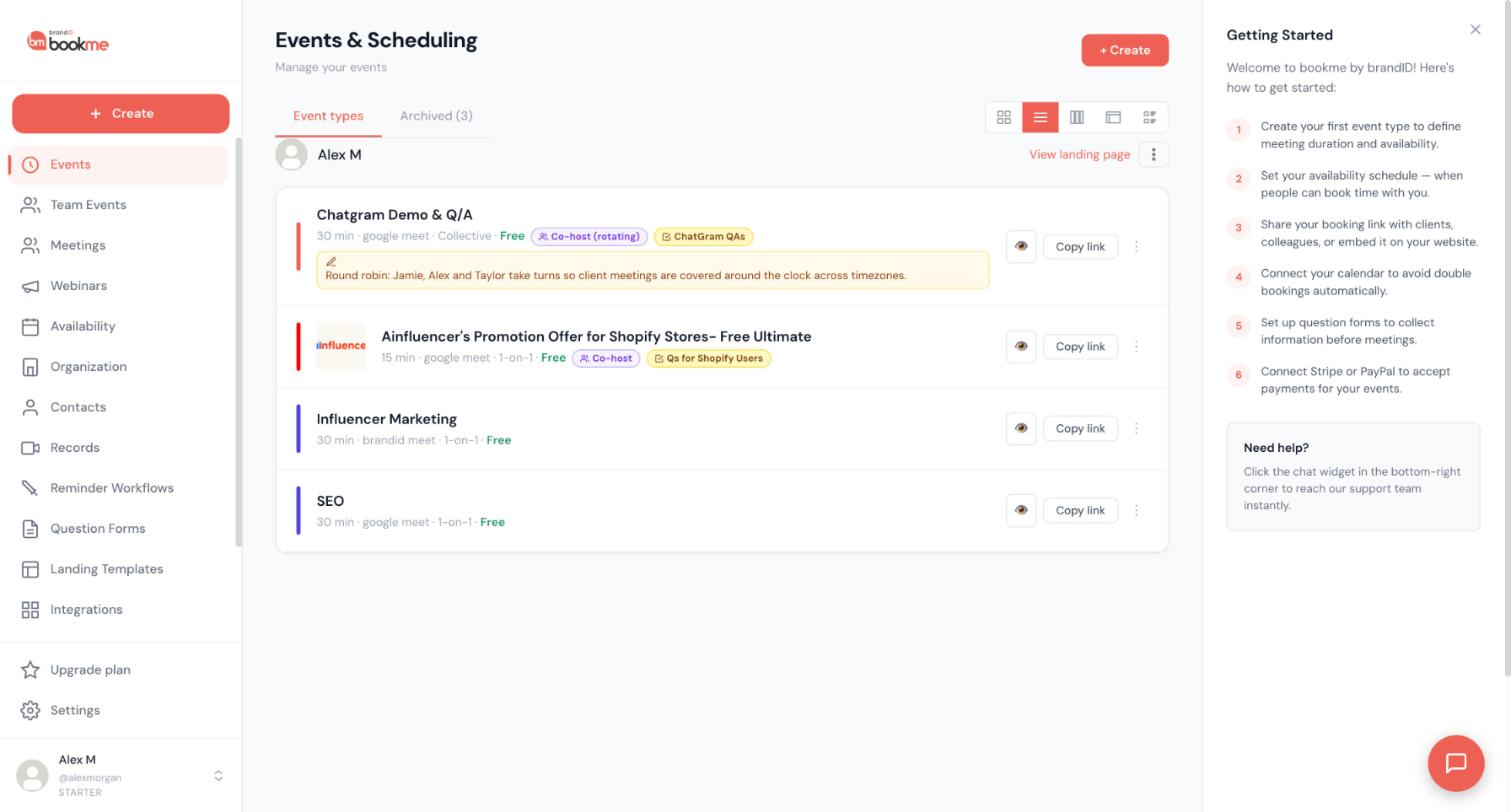
- Click Publish event, then use Copy link on the Events page to get the event’s direct link.
For real estate:
- Create a 30 minute viewing and a 45 minute valuation.
- Name the viewing after the listing when you run one per property.
Full guide: how to create an event type.
Set your hours and protect your week
Travel time is real time.
Your weekly hours decide which times invitees can book. You set them once in a schedule, and every event that uses that schedule follows it.
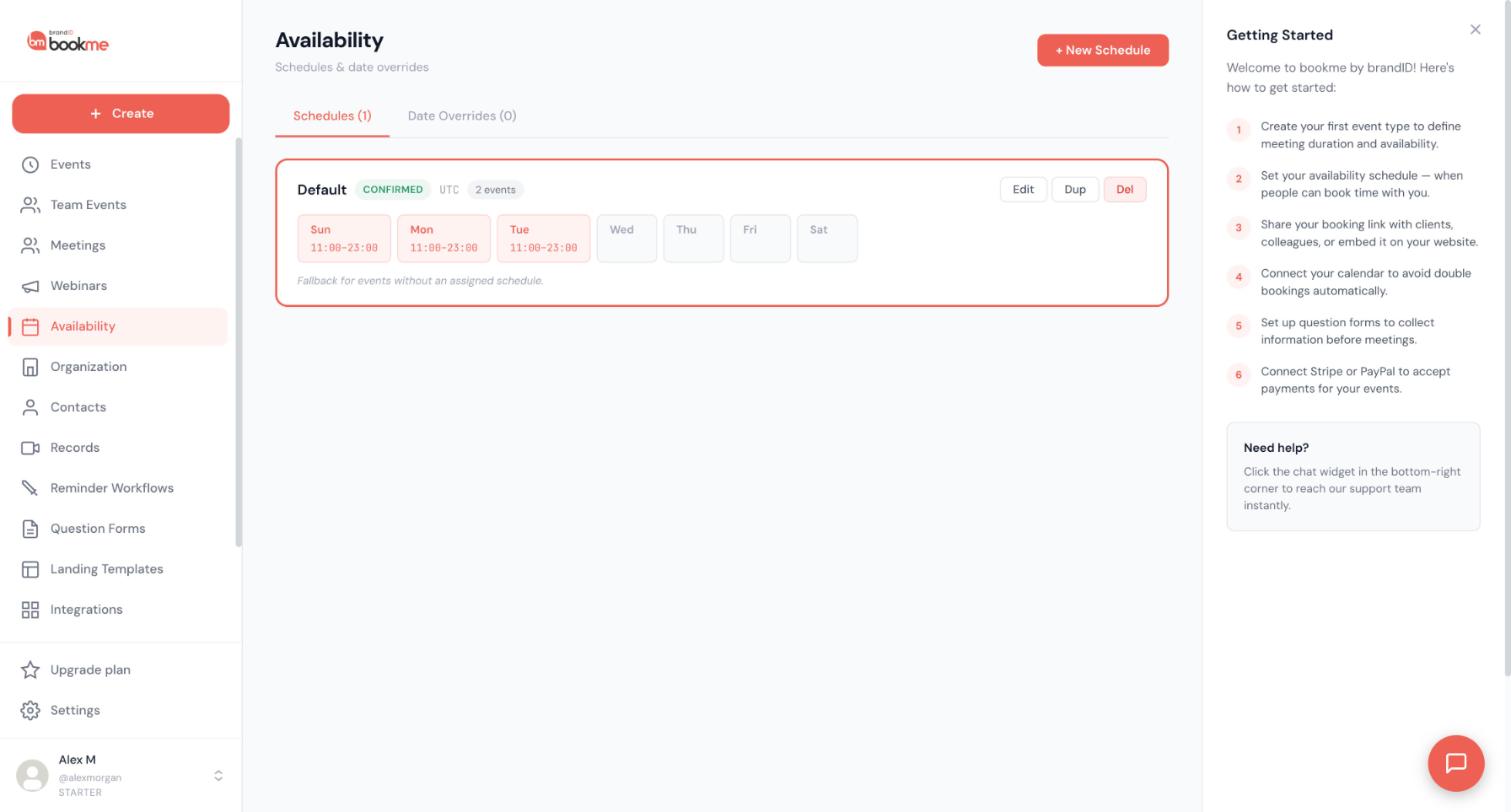
- Click Availability in the sidebar and press Edit on the Default schedule.
- Switch days on or off, set a start and end time, and add more than one time window to a day if you need a break in the middle.
- Use Copy to all to repeat one day’s hours on the others, and check the schedule’s time zone before you save.
- Click + New Schedule when some events need different hours, for example paid sessions only on certain days, then assign that schedule in the event’s Availability step.
- In each event, add a minimum notice, a limit on how far ahead people can book, a cap on bookings per day and buffers before and after.
For real estate:
- Set viewing days and add a buffer after each viewing.
- Keep one slot a day free for admin.
Full guide: how to set your hours and protect your week.
Ask the right questions before the meeting
A few questions tell you who is ready.
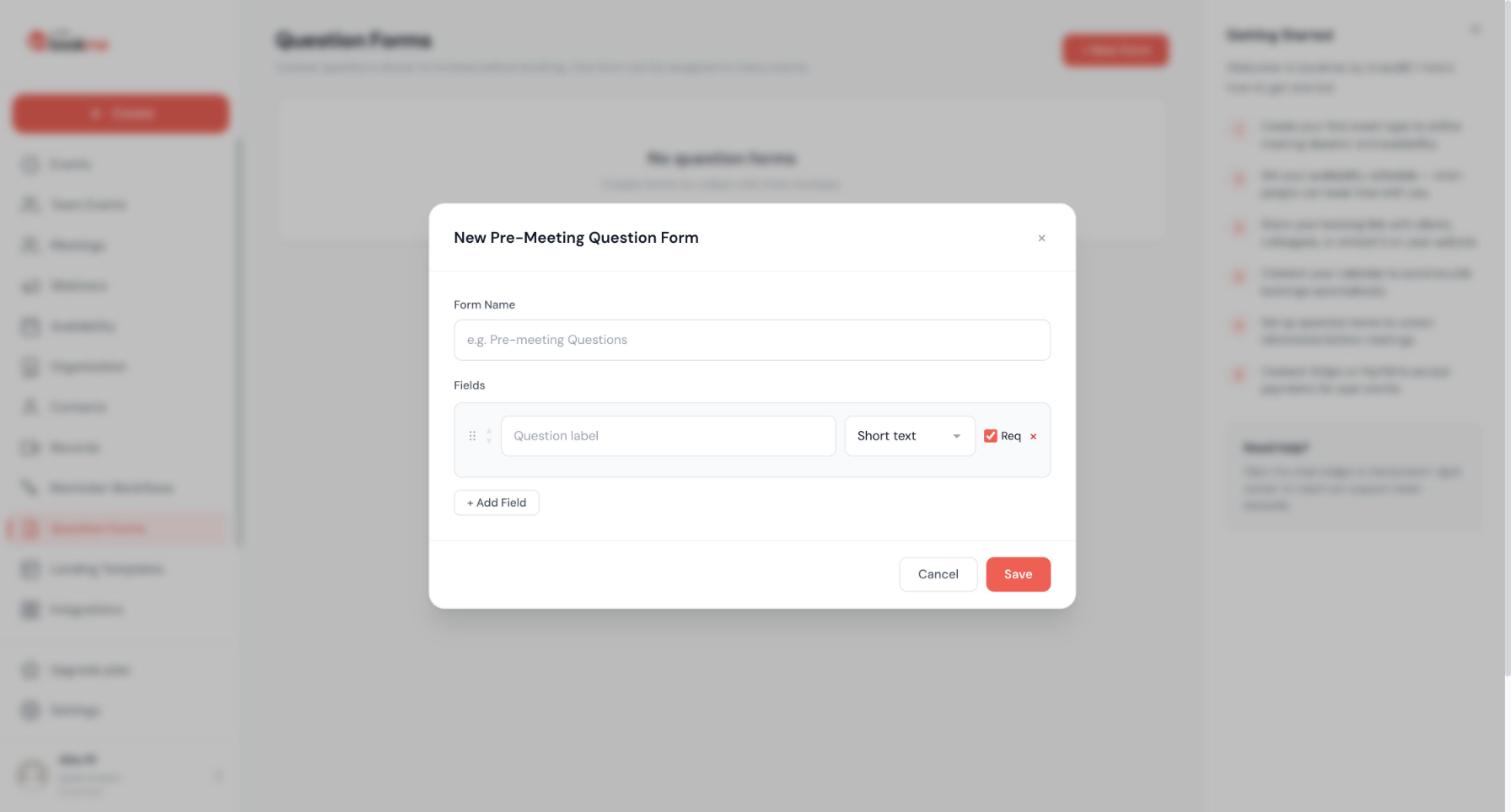
A question form adds your own questions to the booking page, so you know what you need before the meeting. You build it once and reuse it on as many events as you like.
- Click Question Forms in the sidebar, then + New Form, and give the form a clear name.
- Add one row per question. Give each a label, choose a type (short text, long text, dropdown, radio or checkbox) and decide whether it is required.
- Keep it to three or four questions and put the most useful one first. Drag rows to change the order.
- Click Save, then assign the form to one or more event types, or pick it in the Questions step of an event.
- Read the answers in your calendar invite, your booking email, the invitee’s confirmation and the booking in Meetings under What they told you.
For real estate:
- Ask budget range, timeline and whether they are pre approved.
- Keep it to three.
Full guide: how to ask the right questions before the meeting.
Choose how the meeting happens
Out of town buyers can start with a video tour.
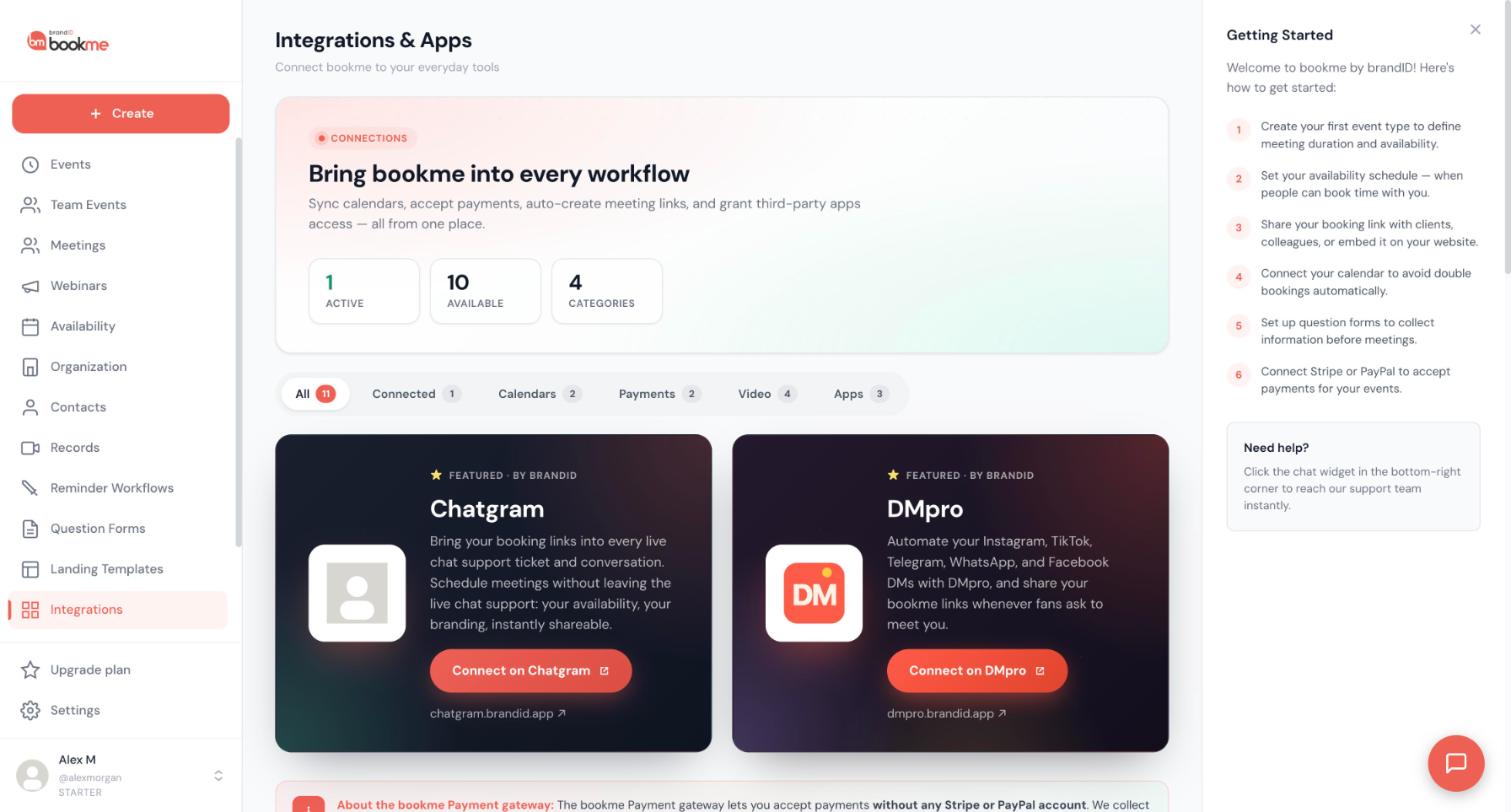
Choose the video tool for each event type and bookme puts a join link in every booking. brandID Meet needs no setup, Google Meet needs a connected Google Calendar, and Zoom needs a one time connection.
- Use brandID Meet with nothing to connect. Each booking gets its own room that runs in the browser, so the invitee installs nothing.
- To use Zoom, open Integrations, find the Zoom card, click Connect and authorize.
- To use Google Meet, connect Google Calendar. bookme then creates a Meet link inside the calendar event for each booking.
- Set the location per event type in the Details step: Google Meet, Zoom, brandID Meet, Phone call or In person.
- Find the join link on any booking in Meetings, where Join and Copy link appear.
For real estate:
- Create a video event with Google Meet or Zoom.
- Keep In person for viewings.
Full guide: how to choose how the meeting happens.
Share your link where people already are
Every listing needs a booking link.
bookme gives you a link for your whole booking page and a direct link for each event type. Copy the one that fits and put it wherever people reach you.
- Use your booking page link when you want people to choose from every live event, and a direct event link when you mean one specific meeting.
- On the Events page click Copy link on an event card, or the small menu next to View landing page for your whole page.
- Click the eye icon to preview an event the way an invitee sees it, and try it on your phone.
- After you publish, copy the email signature line, or use the share buttons and QR code on the event is live screen.
- Keep your username and event slugs stable, because they are part of the links you have already shared.
For real estate:
- Add the viewing link to the listing description and posts.
- Use the email signature line for your own address.
Full guide: how to share your link where people already are.
Automate reminders and follow ups
Reminders help buyers show up.
An email workflow sends an email when something happens around a meeting: before it, after it, or when it is booked, cancelled, rescheduled or marked with an outcome.
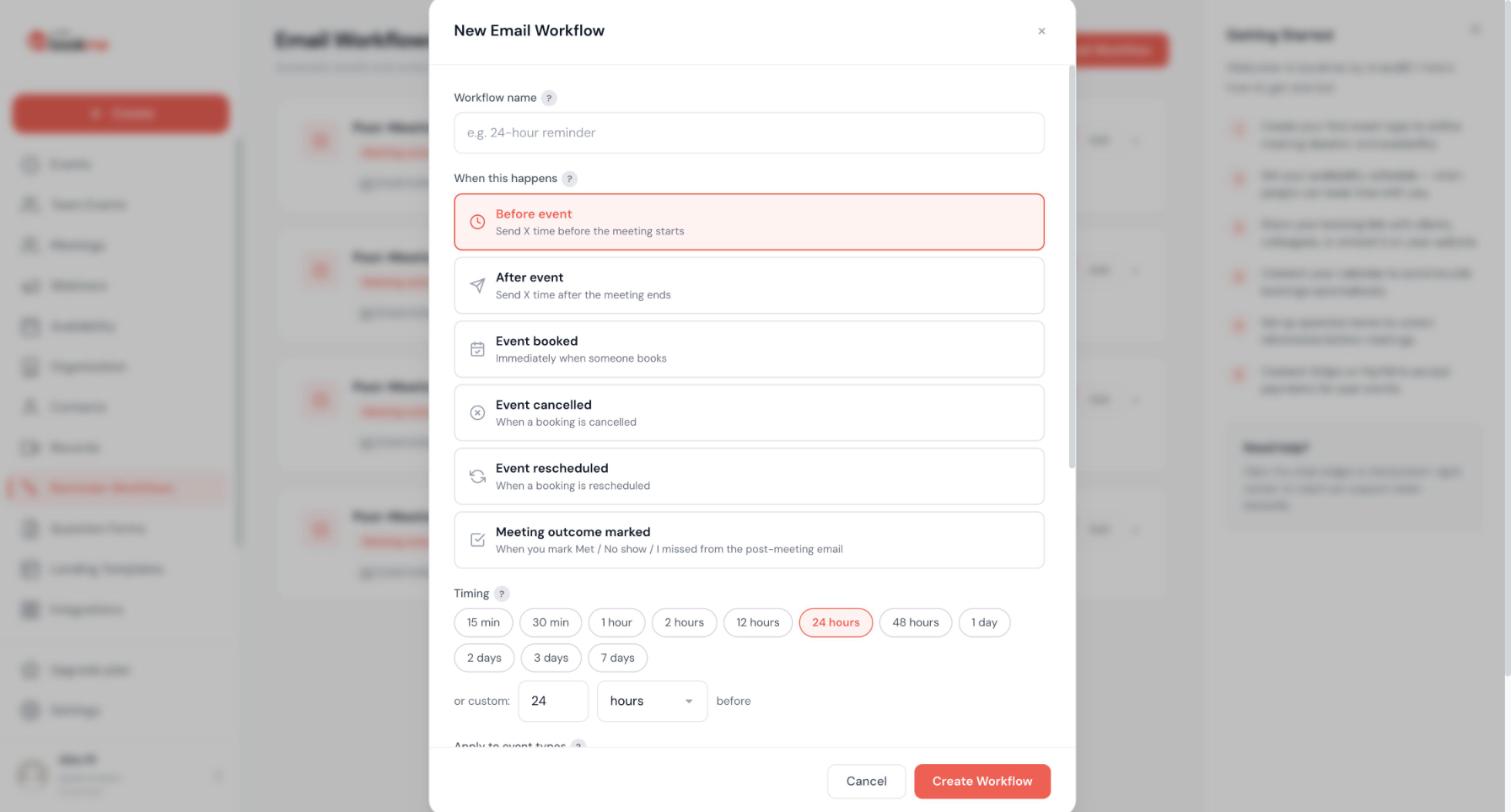
- Click Reminder Workflows in the sidebar, then + New Email Workflow, and name it, for example 24-hour reminder.
- Under When this happens choose a trigger: Before event, After event, Event booked, Event cancelled, Event rescheduled or Meeting outcome marked.
- For before and after triggers pick a timing chip such as 15 min, 1 hour or 24 hours, or enter your own.
- Choose which event types it applies to, leave it empty for all, and write the subject and body. You can insert merge variables such as {{invitee_name}} and {{event_name}}.
- Click Create Workflow and test it first with your own address.
For real estate:
- Send a reminder before each viewing.
- Include the reschedule link in confirmations.
Full guide: how to automate reminders and follow ups.
Case study: an agent booking viewings and valuation calls
An agent creates a 30 minute viewing event with a buffer after it for travel, and a 45 minute valuation consult for sellers. Each listing page links to the viewing event, and the form asks for budget range and move in date.
Out of town buyers choose a video call event instead, using the same booking page.
The agent also uses a longer consultation event for sellers wanting a valuation. Each appears on the same booking page, so clients choose what fits.
Because each booking carries the answers from your form, you can read them before you arrive. A buyer who has stated a budget and a move in date gets a better viewing than one you are meeting cold, and a seller who has described the property lets you prepare comparable examples. The booking page quietly does some of the first conversation for you.
A typical week with bookme
Saturday is viewing day. Buyers book half hour slots with a buffer for travel, and each booking arrives with budget and move in date. During the week, the agent runs consultations by video for sellers and out of town buyers.
Reminders go out before each viewing, and anyone who cannot come uses the reschedule link.
Launch checklist for real estate
Tick these off before you share your link.
- Viewing and valuation events exist.
- Buffers match your real driving times.
- The form asks budget and timing.
- Each listing links to its event.
- Reminders are on.
Common mistakes to avoid
- Scheduling viewings with no travel time.
- Using one link for every kind of meeting.
- Not asking qualifying questions.
Tips that make it work
- Link from each listing. Add the viewing link to the listing description and your listing posts.
- Leave travel time. Set buffers that match your real driving times.
- Offer a video option. Some buyers will start with a virtual tour.
- Block time for admin. Keep one slot a day free for paperwork and follow ups.
Let your AI assistant do the setup
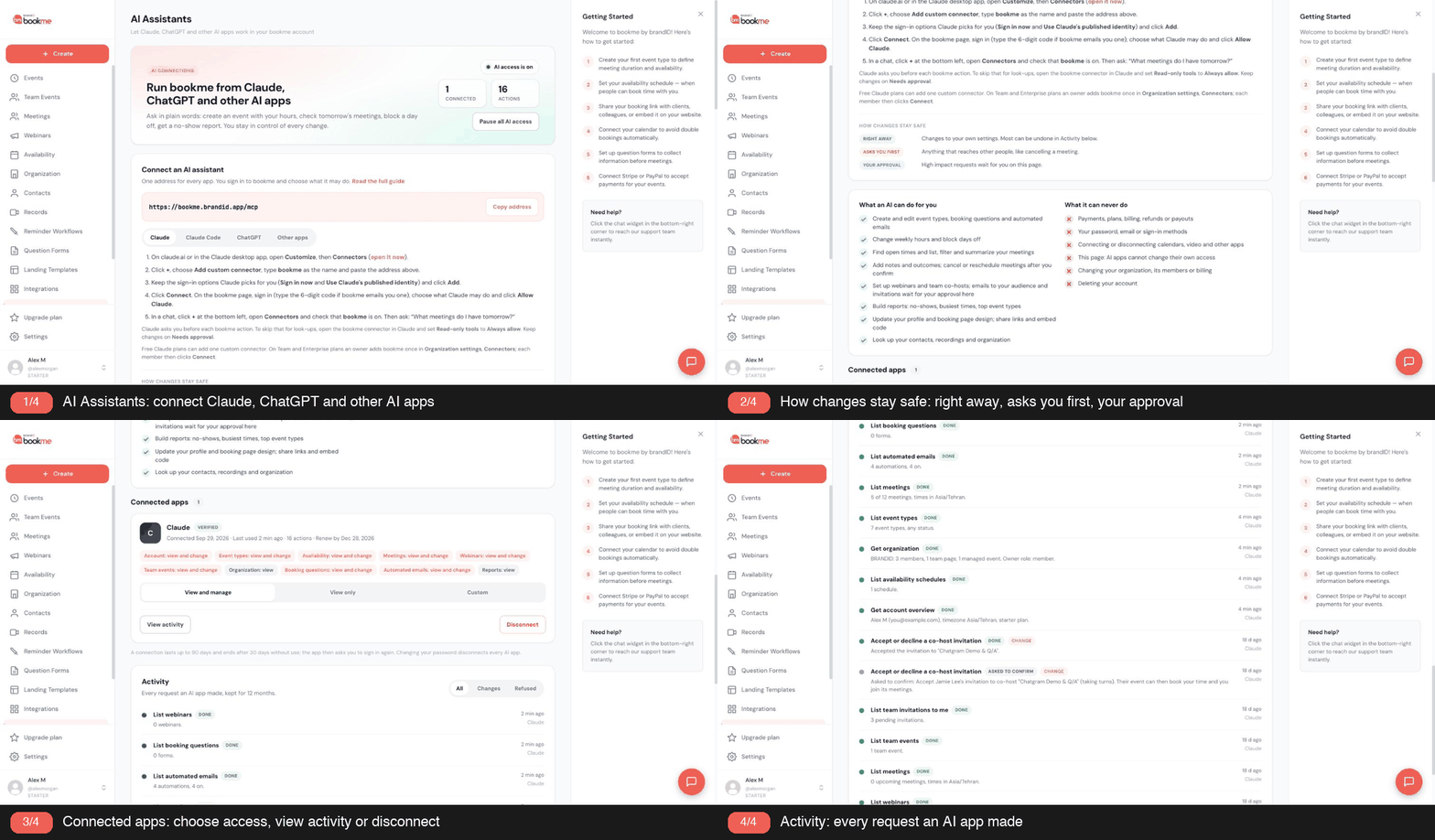
bookme works with Claude, ChatGPT and other MCP apps, so you can describe what you want in plain words and let your assistant build it. Anything that reaches another person, such as cancelling a meeting or emailing an invitee, waits for your approval first. Here is an example request for real estate:
Create a 30 minute in person viewing with a 30 minute buffer after it and a question about budget range and move in date.
Setup guide: how to connect Claude to bookme.
Words you will see
- Event type. A meeting you offer, with its own length, location, price and rules.
- Schedule. A set of weekly hours that events can follow.
- Booking window. How much notice you need, and how far ahead people can book.
- Buffer. Time kept free before or after a booking.
- Question form. Custom questions invitees answer before they book.
- Collective event. All hosts attend, and a time is offered only when every required host is free.
- Round robin. Hosts take turns, with one host per booking.
- Email workflow. An email sent automatically before, after or around a meeting.
- Outcome. What happened to a meeting: Met, No-show, I missed it or Decided to reschedule.
Frequently asked questions
Can I add travel time between viewings?
Can buyers book a video tour?
Can I ask for budget first?
Can invitees reschedule?
Can I use one link for all listings?
Ready to try it?
Create a viewing event, add buffers, and put the link on your next listing.